Decline of condom vending machines in Japan
They were once a common sight, tucked among the backstreets of a residential area or perhaps to the side of a local shopping arcade: condom vending machines in Japan.
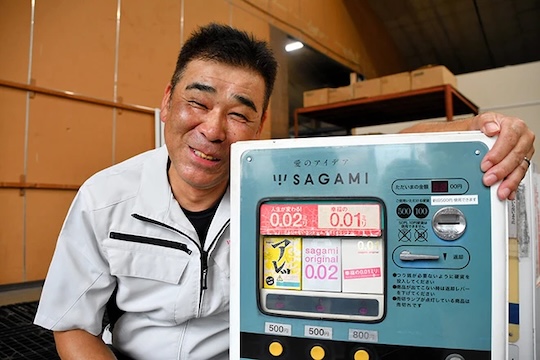
They usually sell just one brand of condom, sometimes even just a single type. They originally existed so men caught short could pop and get a small pack without needing to travel to a shopping district.
The machines are quite small (especially compared to the bulky yet ubiquitous drink vending machines) and may be daubed with tacky slogans in dubious English and other languages like “Happy family” and “Ich liebe dich.”
However, with the spread of condom sales at drugstores, convenience stores, and online, it is now easy to get your supplies of contraceptives without needing to risk a neighbor seeing you.
There were once 30,000 condom vending machines in Japan, but those numbers have dwindled and often, at least in Tokyo, if you do spot one, it is old and no longer in use. In fact, the Asahi Shimbun reports, the condom manufacturers stopped making them a quarter-century ago, so there are no “young” machines anymore.
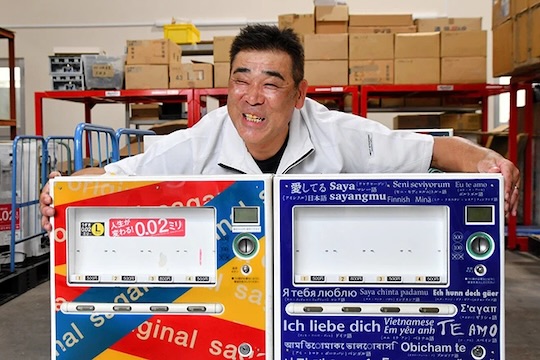
The Asahi has published a recent article about the decline of the machines, featuring an interview with an engineer from condom manufacturer Sagami Rubber whose job is to repair the aging machines.
“These machines will soon go to heaven,” laments 57-year-old Atsushi Takahashi as he hugs an old machine.
Takahashi is one of a team of three, whose oldest member is 71, and who regard the vending machines as their “children.” They repair and refurbish about 10 machines per month.
“Even if 100 machines come back, about 30 have no usable parts left and must be scrapped,” Takahashi said. “From the other 70, we gather every part we can and bring them back to life.”
Condom machines were once a major business.
Sagami Rubber started making condom vending machines in the 1970s and set them up mainly outside independently owned pharmacies.
At a time when many people felt uncomfortable buying contraceptives face to face, the machines offered a discreet, 24-hour alternative.
At their peak in 1993, condom vending machines generated an estimated 4 billion yen ($255 million) in annual sales nationwide.
Sagami Rubber alone managed about 10,000 machines.
By June 2026, that number had fallen to 1,540.
Sales through the machines have also declined sharply, from 1.14 million condoms worth ¥105 million in fiscal 2018 to 410,000 units worth ¥51 million in fiscal 2025.
Nationwide, only three or four machines generate more than ¥10,000 in monthly sales, according to the company.
“As a business, it’s not rational. It’s a money-losing business,” said Muneto Tamagami, a director at Sagami Rubber. “But as long as there are customers buying from them, we can’t simply shut it down. It remains a sales method that serves users’ needs.”
But Tamagami acknowledged that change is likely inevitable.
“The challenge now is figuring out how to reshape the business so that it remains viable,” he said.
Another factor is a possible decline in condom use (and thus sales) as people apparently have less sex or have sex, just without protection (and to the government’s chagrin, not because people are having more kids).
This is in spite of the fact that Japanese condoms are the among the thinnest and best in the world.
But such condom machines are also a part of sex education. Young kids walk by them and become familiar with what protection is (and where to get one).
“People tend to see condoms as adult goods, but that’s not what they are,” said Shoma Wada, who oversees the condom business at Okamoto.
He stressed that condoms remain essential for both contraception and preventing sexually transmitted infections.
Wada also serves as a guest lecturer in sex-education classes at junior high schools. After one class held during a school open house, parents voiced heartfelt concerns, saying they had struggled with how to discuss such topics with their children.
“I remember buying one from a vending machine for the first time in junior high school, partly as a joke,” Wada said. “They were even installed outside liquor stores and were part of the scenery of everyday life.”
Looking back, he believes the machines served a broader role.
“When young people became curious about sex, vending machines allowed them to encounter condoms naturally.”
Okamoto is faring even worse than Sagami. It likewise once had 10,000 machines but is now down to 250.
Takahashi is melancholic about the decline.
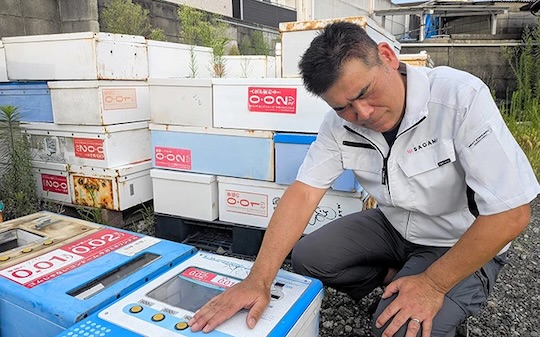
“It makes me happy when I see one still standing in its old place,” he said. “When it’s gone, I feel sad. “But I think condom vending machines are part of our culture. I imagine there are other people besides me who would feel sad if they disappeared.”